The server only stores encrypted data it cannot read. Even if compromised, your messages remain private.
Burn Message
Encrypted self-destructing messages. Read once, then gone forever.
Press Ctrl+Enter to encrypt
Burn Message
You received a secret message
This message can only be read once. After you read it, it will be permanently destroyed.
How It Works
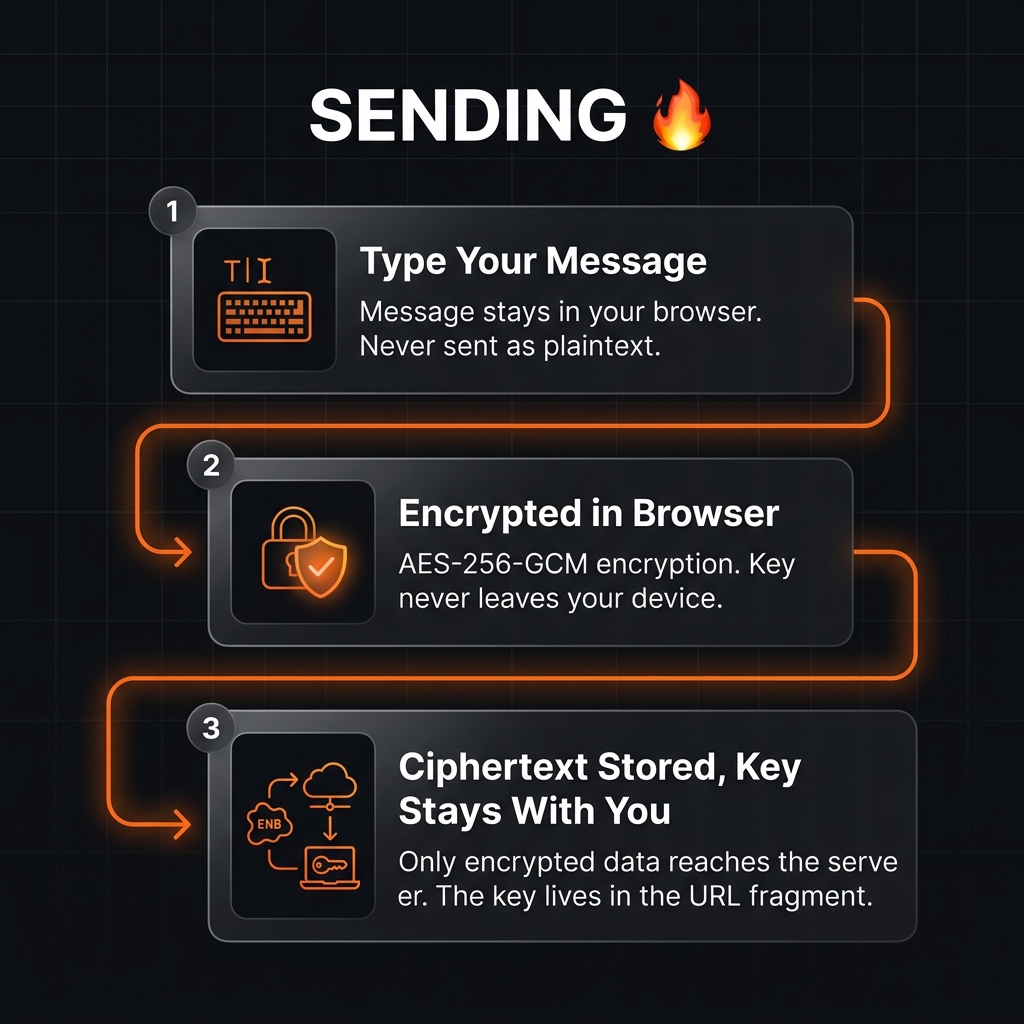
Sending
-
1
You type your message
Your message stays in your browser — it's never sent as plaintext.
-
2
Encrypted in your browser
AES-256-GCM encryption creates a locked ciphertext. The key never leaves your device — it is never sent to any server.
-
3
Ciphertext stored, key stays with you
Only the encrypted blob is sent to the server. The decryption key lives in the link's
#fragment — a part of the URL that browsers never transmit to the server.
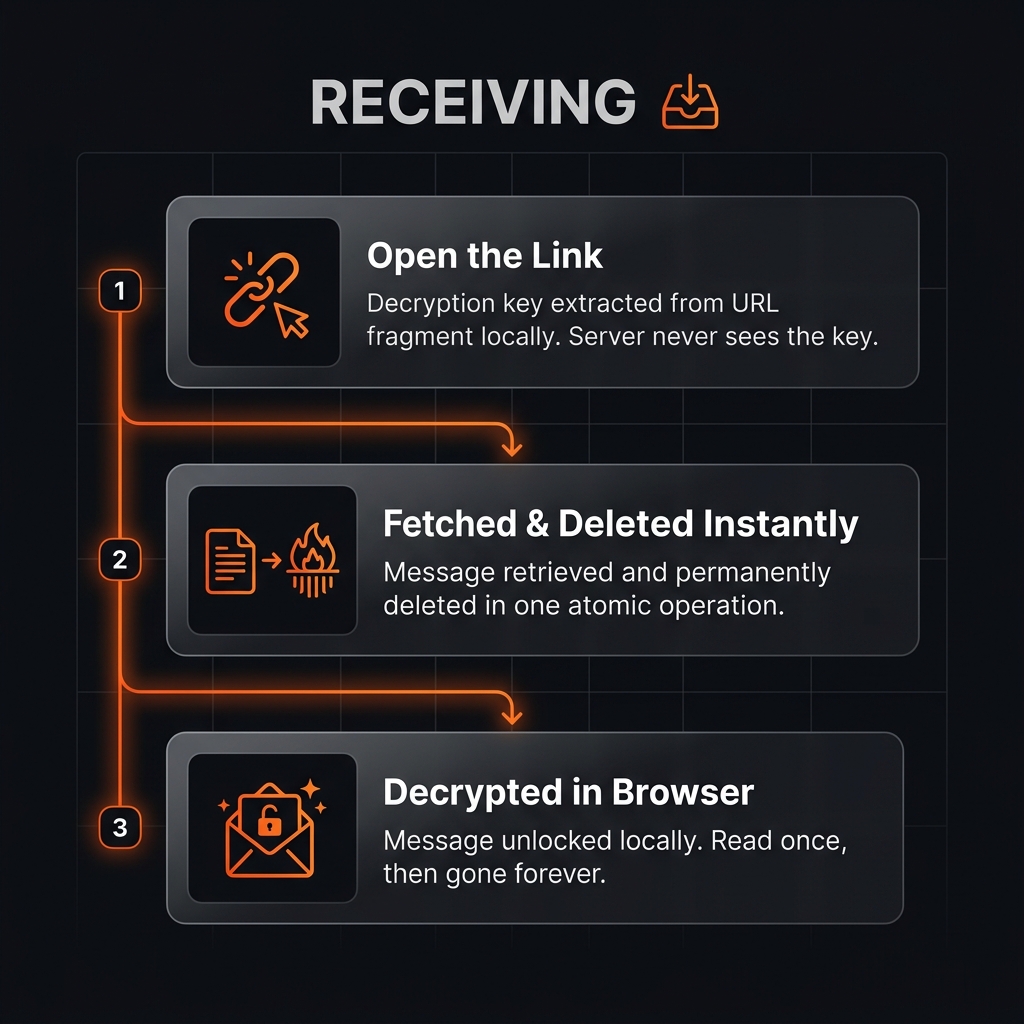
Receiving
-
1
Recipient opens the link
The decryption key is extracted from the URL
#fragment locally. The server never sees the key — only encrypted data. -
2
Fetched and deleted instantly
The encrypted message is retrieved and permanently deleted from the server in one atomic operation.
-
3
Decrypted in the browser
The message is unlocked locally and displayed. It can never be read again — it's gone forever.
Frequently Asked Questions
Security & Encryption
What encryption does Burn Message use?
Burn Message uses AES-256-GCM (Advanced Encryption Standard with Galois/Counter Mode) — the same encryption standard used by governments and financial institutions worldwide. Encryption and decryption happen entirely in your browser using the Web Crypto API, meaning your plaintext message never leaves your device.
What does "zero-knowledge" mean?
Zero-knowledge means our server never has access to your message content. The decryption key is embedded in the URL fragment (the part after the #), which browsers never send to the server. Even if our database were compromised, an attacker would only find encrypted blobs — completely unreadable without the key.
Can BytesBit read my messages?
No. We physically cannot read your messages. The encryption key exists only in the link you share — it is never transmitted to or stored on our servers. We only store the encrypted ciphertext, which is meaningless without the key. This is true zero-knowledge architecture.
Is this safe for sharing passwords and API keys?
Yes. Burn Message is specifically designed for sharing sensitive credentials like passwords, API keys, tokens, and private notes. The one-time-read mechanism ensures the data is permanently destroyed after the recipient views it, and the zero-knowledge encryption ensures it cannot be intercepted in transit or at rest.
How is this different from sending a password in an email?
Emails are stored indefinitely on mail servers, can be forwarded, and are often unencrypted in transit. Burn Message links are: (1) encrypted end-to-end, (2) readable only once, (3) permanently deleted after reading, and (4) auto-expire after 24 hours even if unread. There's no persistent copy anywhere.
Usage & Features
How long does a message link stay active?
Unread messages automatically expire and are permanently deleted after 24 hours. Once a message is read, it is deleted immediately — there is no recovery. This dual mechanism ensures messages don't linger indefinitely.
Can I read a message more than once?
No. Each message can only be read exactly once. The moment the recipient clicks to reveal the message, the encrypted data is fetched from the server and permanently deleted in a single atomic operation. If you need to reference the content, copy it when you first read it.
What happens if I open the link but the message is gone?
You'll see an "Already Burned" screen indicating the message has already been read by someone or has expired. If you expected to read it but see this screen, it's possible someone else accessed the link first — this is by design to alert you to potential interception.
Is there a character limit for messages?
Messages can be up to 10,000 characters. This is enough for most use cases including passwords, multi-line API keys, configuration blocks, and private notes. The encrypted payload size will be slightly larger than the plaintext.
Do I need to create an account?
No. Burn Message requires zero signup. No email, no username, no account. Just type your message, click encrypt, and share the link. The tool is completely free and anonymous.
Can I send files or images?
Currently, Burn Message supports text-only messages. For files and images, we recommend encrypting them separately and sharing the decryption key via a Burn Message link. File support may be added in a future update.
Technical Details
Where is the encryption key stored?
The encryption key is embedded in the URL fragment (the portion after the # symbol). Per the HTTP specification, URL fragments are never sent to the server — they are processed entirely by the browser. This means the key only exists in the link itself and in the recipient's browser memory during decryption.
What happens to the data on your servers?
Encrypted message data is stored temporarily in our database. It is permanently deleted in one of two ways: (1) immediately when the recipient reads the message (atomic read-and-delete), or (2) automatically after 24 hours via a server-side expiration policy. No backups of burned messages are retained.
Will Slack, Teams, or Discord link previews burn my message?
No. We've implemented a "click-to-reveal" gate that prevents automated link-preview bots from triggering the one-time read. When a bot crawls the link, it sees the gate page but cannot execute the JavaScript required to fetch and delete the message. Only a real user clicking the reveal button will consume the message.
Does Burn Message work offline?
Creating and reading messages requires an internet connection (to store and retrieve encrypted data from the server). However, Burn Message is a Progressive Web App (PWA) — you can install it to your device for quick access, and the app shell will load even offline. You'll need connectivity to actually send or read messages.
Is the source code auditable?
The entire encryption and decryption process runs in your browser as client-side JavaScript, which is fully inspectable via your browser's developer tools. You can verify that (1) the key is generated locally, (2) encryption uses standard Web Crypto APIs, and (3) the key is never included in any network request.
Privacy & Compliance
Do you log IP addresses or track users?
We do not associate IP addresses with specific messages. Standard web server logs may exist at the infrastructure level (as with any website), but there is no mechanism to connect a log entry to a specific message's content, since all content is encrypted and we don't have the keys.
Is Burn Message GDPR compliant?
Burn Message is privacy-by-design. We store no personal data, require no account, and automatically delete all encrypted data within 24 hours. Since we cannot decrypt message content (zero-knowledge), we don't process personal data in the GDPR sense. No cookies are used for tracking.
Can law enforcement access my messages?
Even if compelled by legal process, we can only provide encrypted ciphertext — which is unreadable without the decryption key that we never possess. Once a message is burned or expires, the data is permanently deleted from our servers with no backup or recovery mechanism.
What data do you store?
We store only three things per message: (1) a random UUID identifier, (2) the AES-256-GCM encrypted ciphertext, and (3) a creation timestamp for expiration. No sender info, no recipient info, no IP associations, no metadata about message content. Everything is deleted within 24 hours or upon first read.